
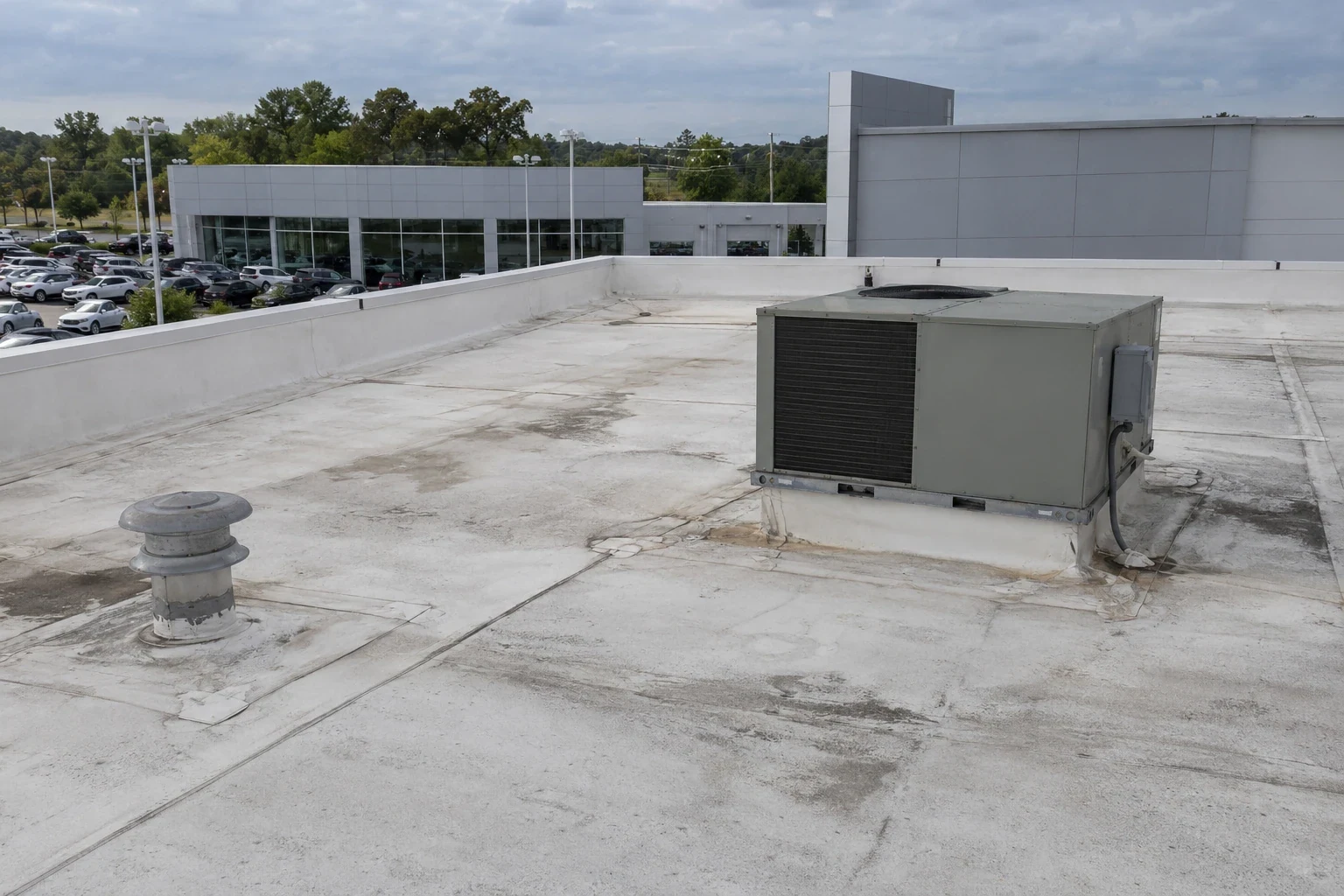
A dealership roof covers several very different spaces: a showroom with finished ceilings and customers, offices for sales and finance, a parts room, and service bays full of customer vehicles and expensive equipment. A leak over a car in the service drive or a new vehicle on the showroom floor turns into a customer problem fast. In Chesapeake, many dealership leaks start at rooftop HVAC curbs and exhaust penetrations, especially over service bays, where there is a lot of equipment on the roof and a lot of heat and vibration below.
Curb leaks are often misdiagnosed. Water can come in at the curb flashing, at the seal between the unit and the curb, through a condensate line or even through the unit's own cabinet. Each one has a different fix and sometimes a different contractor. We inspect the curb, the unit connection and the roof around it, check whether the insulation is wet, and give you photos and a written explanation of the cause. If part of the fix belongs to your HVAC contractor, we tell you exactly which part, so you are not paying the wrong trade to chase the leak.
Curbs and penetrations
Rooftop units vibrate, and over time that movement can open the joint between the unit and the curb or crack the flashing at the base of the curb. Sealant applied over a moving joint lasts a short time and then lets go again. We look at how the curb is flashed, how high the flashing is above the roof surface, whether the counterflashing is secure, and whether the curb itself is sound. Short curbs on older buildings are a common problem because water can wash over the top of the flashing in heavy rain.
Our rooftop curb and equipment support work covers rebuilding curb flashings, raising curbs where needed and repairing equipment supports. Service bays often have exhaust fans, vent stacks and other pipes through the roof, and our penetration and flashing repair service handles those details with proper boots and flashings instead of pitch pans filled with sealant. Each repair is made so water drains away from the penetration instead of collecting around it.
Keeping the service drive working
Dealerships rarely want to close the service department for roof work. That means planning around where vehicles are parked, which bays are in use, and when customers are on site. Before any area is opened, we agree with the service manager on which bays need to be cleared or covered and which vehicles have to be moved. Debris, fasteners and old roofing material can fall during repairs, and nobody wants a scratched customer car.
Our roofing for occupied buildings approach keeps the open area small, schedules noisy or odor-producing work early or after hours where possible, and seals the roof at the end of each day. Crane lifts are planned away from customer parking and the inventory lot. Walkways and entrances stay clear. The general manager or facilities contact gets a short update each day so the staff knows what to expect and can answer customer questions.
Finding the wet insulation
A curb that has leaked for a while usually leaves wet insulation around it, sometimes spreading well beyond the curb. Fixing the flashing without replacing that wet material leaves a soft spot that holds water against the deck, rusts steel and keeps the roof from drying out. Wet insulation also loses much of its value, so the building costs more to cool in the summer. We find the wet area before we price the repair, so the quote reflects the real work.
An infrared moisture survey can map wet insulation across a large roof in one evening, which is useful when several curbs or areas are suspect. We confirm the scan with core samples in key spots, because thermal images can be misleading on some roofs. Once the wet area is known, we cut it out, replace the insulation and tie the new membrane into dry roof. Any surprise once the roof is open is photographed and approved before we expand the work.
Local dealership properties
Chesapeake dealerships range from older single-story buildings with flat roofs over the service area to newer facilities with large showroom glass, metal canopies and separate service buildings. Commercial areas such as Greenbrier have a mix of building ages and roof types, so we base each repair on an inspection of the specific building rather than assuming it matches the store down the road. Franchise brand requirements sometimes affect the appearance of the building, and we keep those in mind for any visible edge or canopy work.
To get started, the facility contact tells us which rooms leak, which rooftop units sit above them and when the problem happens, such as only in heavy rain or whenever the HVAC is running. We inspect the roof and equipment, check for wet insulation and look at the drains. The proposal explains the cause, the roofing repair, any HVAC or other trade work and how we will keep the dealership operating during the job. Photos are included so the dealer principal or property owner can see what we saw.
Similar buildings
Flex industrial buildings often combine offices with shop or warehouse space, much like a dealership combines a showroom with service bays. Our flex industrial roofing page covers how we handle leaks across multiple tenant spaces with different uses below. The same thinking applies: find the actual source, protect what is underneath, and keep the business running while the roof is repaired.
Dealership sales and finance areas are basically offices, with finished ceilings, computers and paperwork below. Our office building roofing page explains how we work above occupied office space with minimal disruption. Whatever the building, the closeout is the same: photos of the finished work, a description of what was repaired and what materials were used, and a list of anything another trade still needs to take care.
Commercial Roofing Questions
Why does the HVAC curb keep leaking after it is sealed?
Rooftop units vibrate and the joint moves, so sealant alone breaks loose again. The curb flashing usually needs to be rebuilt, and sometimes the curb needs to be raised.
Is the leak always from the roof?
Not always. Water can come from the unit itself, the seal between the unit and the curb, or a condensate line. We figure out which, so the right contractor fixes it.
Can the service department stay open during roof work?
Usually, yes. We clear or protect only the bays under the active work area, keep open sections small and seal the roof each day.
Why replace wet insulation around the curb?
Wet insulation holds water against the deck, causes rust and keeps leaking. Replacing it is part of a lasting repair.
What do we get when the job is done?
Photos, a description of the repairs and materials, and a list of any work that still needs an HVAC contractor or another trade.
Have the dealership curb leak inspected
Tell us which rooms are leaking and which rooftop units sit above them. We will trace the water at the curb and send photos with a written repair plan.