
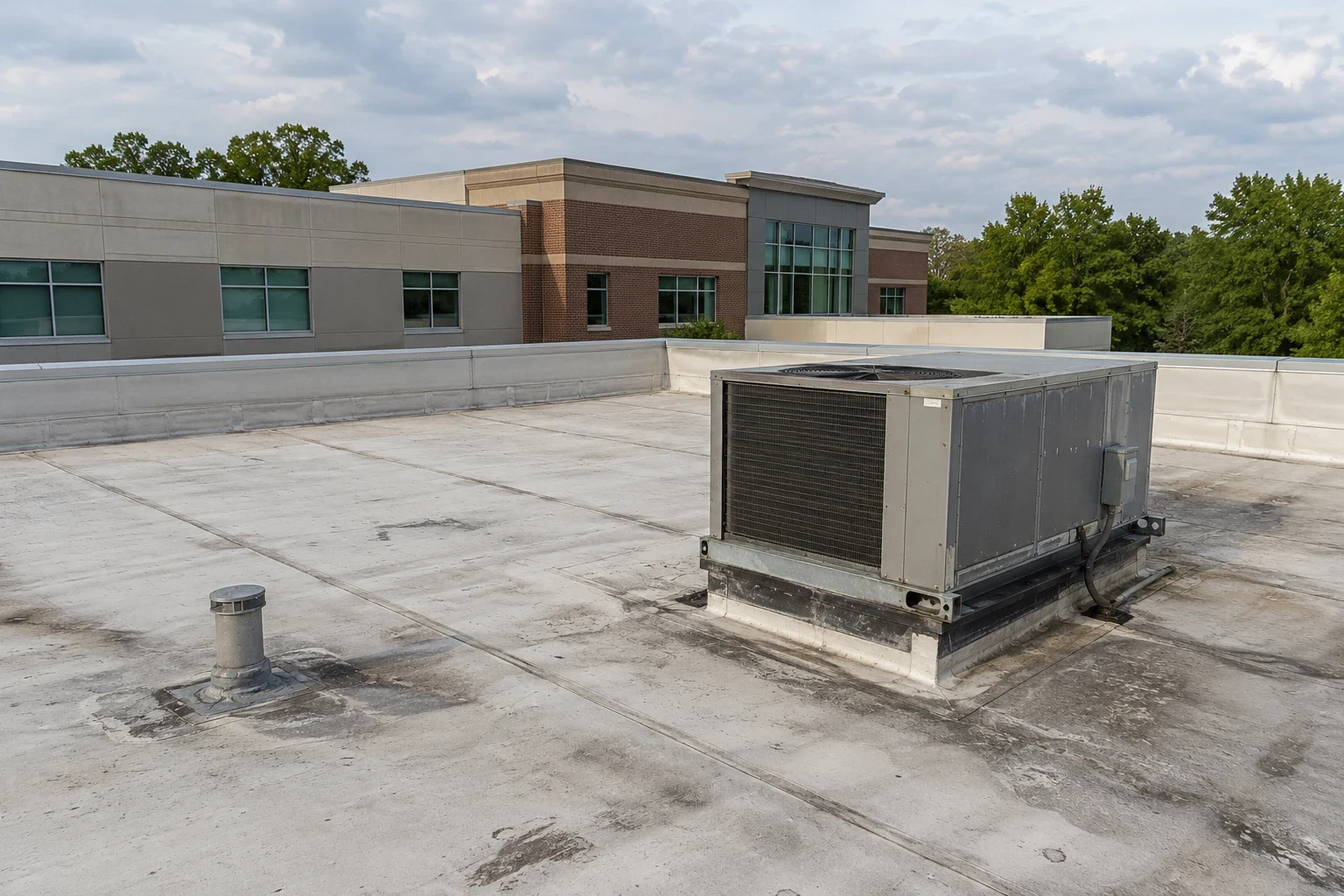
Medical office buildings hold exam rooms, procedure rooms, labs, imaging equipment and records, and they see patients all day. A leak over an exam room means canceled appointments, and wet ceiling tiles in a clinical area raise infection-control concerns. Most medical office roofs in Chesapeake are low-slope roofs with several HVAC units, because clinics need more air changes and tighter temperature control than ordinary offices. The curbs under those units are where we find most leaks.
A curb leak often hides under the equipment itself. The flashing at the back of the curb, the seal between the unit and the curb, or a corner that cracked years ago may be out of sight unless you know where to look. Some water may come from the unit or its condensate line rather than the roof. We inspect the curb from all sides, check the unit connection and test the insulation around it for moisture. You get photos and a written explanation of the cause, the repair and who should handle each part, along with a schedule that works around patient hours.
The curb behind the unit
Rooftop units often sit close to the curb edge, and the back or underside of the curb is hard to see. That is exactly where flashing tends to crack, pull loose or sit too low for heavy rain. On older buildings, the wood curb itself may be rotted from years of slow leaks, so new flashing has nothing solid to fasten to. Smearing sealant along the visible edge rarely solves the problem because the opening is somewhere else.
Our rooftop curb and equipment support work covers removing the old flashing, repairing or replacing rotted curbs, raising short curbs and installing new flashing and counterflashing all the way around. When a unit needs to be lifted to reach the curb properly, we schedule that with your HVAC contractor so the work is done once and done right. We also check condensate lines, since a clogged or disconnected line can dump water right next to the curb and look like a roof leak.
Protecting clinical areas
Before any section of roof is opened, we review what is below it with the practice manager or property manager. Exam and procedure rooms may need to be closed during work above them, or the work may need to happen before or after patient hours. Sensitive equipment such as imaging machines, lab instruments and sterilizers gets extra protection, and ceiling areas below the work may be covered. Medical records and computer rooms are protected the same way.
Our roofing for occupied buildings method keeps each work area small and dries it in before the crew leaves. Odor-producing adhesives are kept away from air intakes, and low-odor products are used where they make sense. Noisy work is scheduled with the practice so it does not disrupt procedures or patient conversations.
Entrances, accessible parking and drop-off areas stay clear for patients, many of whom may have limited mobility. The office gets a short daily update so staff can plan appointments around the work. If a procedure is scheduled that cannot be interrupted, we pause or move to another section of the roof.
How far the damage goes
A curb that has leaked for a while usually leaves wet insulation around it, and that wet area can spread several feet. Replacing the flashing without replacing wet insulation leaves a soft spot that keeps holding water against the deck. An infrared moisture survey can map wet areas across the roof, which is helpful when several units or areas are suspect. We confirm the scan with core samples, because HVAC equipment and recent rain can affect the readings.
Once the wet area is known, a commercial roof repair replaces the wet insulation and brings new membrane back over dry, solid roof. Should the deck turn out to be damaged, you see photos and approve the added work first. If the wet area is large, we price a focused repair and a larger replacement side by side, so the owner can weigh cost against disruption to the practice. Active leaks can get a temporary repair right away while the permanent fix is scheduled.
Medical offices in Chesapeake
Medical office buildings in Chesapeake range from single-practice buildings to multi-tenant medical plazas, including buildings near Great Bridge and around the hospital campus on Battlefield Boulevard. Each has its own roof type, age and equipment. For medical office roofing around Great Bridge, we inspect the specific building and base the repair on what we find there, rather than assuming it matches the building next door.
The property or practice manager tells us where leaks appear, which rooms are most sensitive and who services the HVAC equipment. We inspect the curbs, drains, seams and flashings and test the insulation. The proposal explains the cause, the repair, the schedule and how patient areas will be protected. In multi-tenant buildings, findings are organized by suite so each practice knows how it will be affected. HVAC or plumbing items are listed separately for the right contractor. Photos are labeled by roof area and the rooms below so the practice can match them to the leak reports.
Related buildings and records
General office buildings share many of the same concerns without the clinical requirements, and our office building roofing page covers them. Hospitals take everything a step further, with operating rooms, round-the-clock care and strict infection control. Our hospital roofing page explains how we plan roof work around those needs. Many of the same protections for clinical rooms apply to busy outpatient practices as well.
At closeout, the medical office receives photos of each repair, a roof plan showing the work, a list of materials and notes on any items for other contractors. Those records help when HVAC equipment is replaced, since every new unit needs a properly flashed curb. Regular inspections in spring and fall, and after major storms, are the most cost-effective way to keep leaks away from exam rooms and patients. A brief report after each visit keeps the owner and practice manager informed and helps plan budgets.
Commercial Roofing Questions
Why is the leak behind the rooftop unit hard to find?
The back of the curb and the seal under the unit are often hidden from view. We inspect the curb from all sides and check the unit connection to find the actual opening.
Could the water be coming from the HVAC unit?
Yes. Condensate lines and unit cabinets can leak too. We check them and tell you whether the HVAC contractor or the roofer should make the repair.
Can the practice stay open during roof work?
Usually. We schedule work around patient hours, protect sensitive rooms and equipment, keep open areas small and seal the roof every day.
Why replace wet insulation around the curb?
Wet insulation holds water against the deck and keeps feeding leaks. A lasting repair replaces it before new flashing goes on.
What records do we receive?
Photos, a roof plan of the repairs, a materials list and notes on any HVAC or plumbing items for other contractors.
Have the medical office roof leak inspected
Tell us which rooms are affected and who services the rooftop equipment. We will inspect the roof and send photos with a clear repair plan and how we will protect patient areas.