
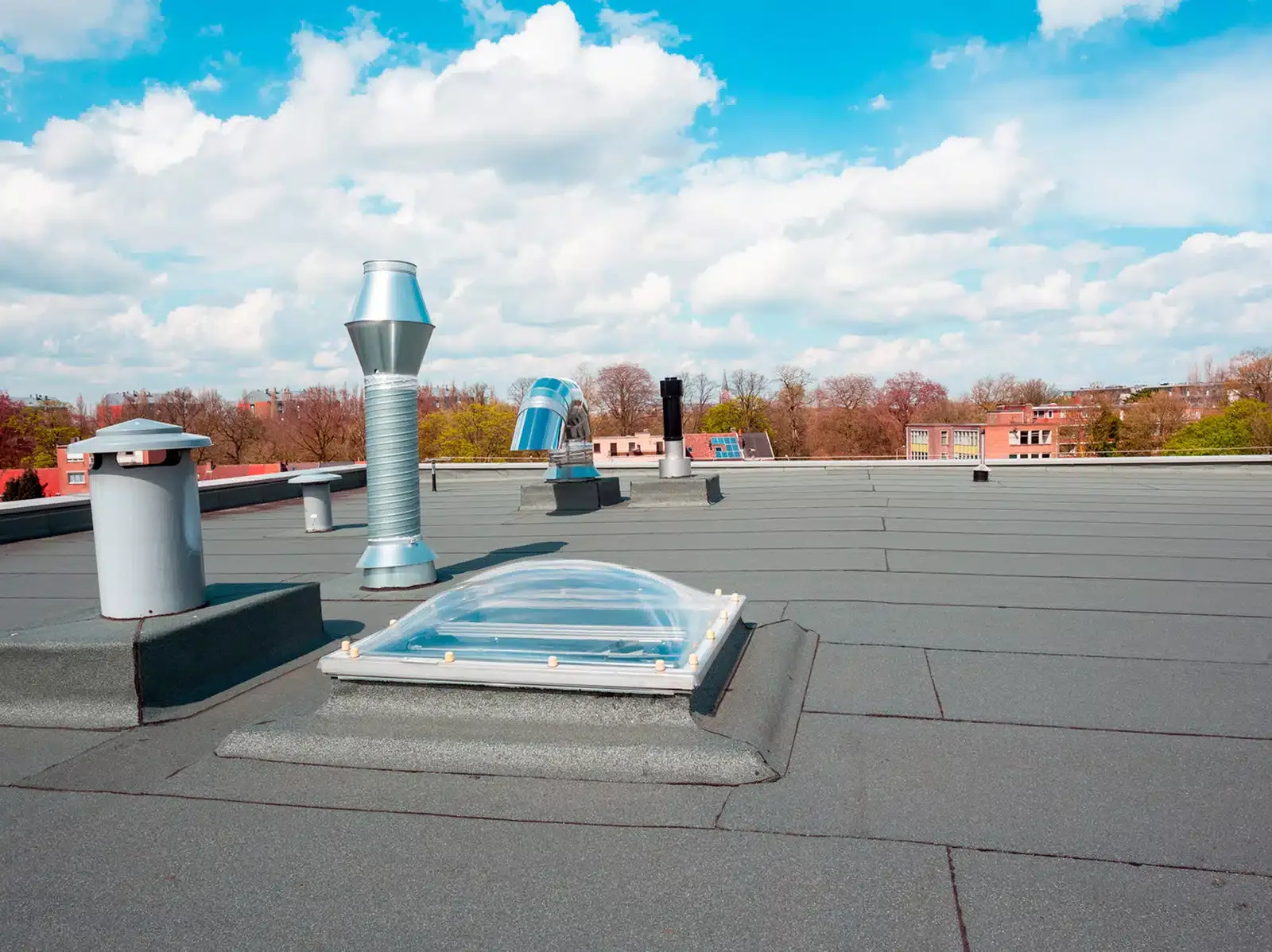
Most Duro-Last leaks we see in Chesapeake start at a detail, not in the open field of the roof. A prefabricated boot that no longer fits a replaced unit, a stack that was moved, a curb that was raised during an HVAC swap. Rain finds that gap, runs under the membrane and shows up as a stain somewhere else entirely. Knowing the roof is Duro-Last tells us what material we are working with. It does not tell us why the detail opened, so we start by looking at the detail itself and the roof around it.
On the first visit we confirm the membrane, measure the curbs, pipes and edges that need new flashing, and check whether the insulation under the leak is still dry. If someone has an old shop drawing, we compare it with what is actually on the roof, because equipment changes over the years and drawings rarely get updated. You get photos, measurements and a written repair recommendation that matches the roof as it stands today.
What a Duro-Last roof actually is
Duro-Last is known for PVC membrane and for accessories fabricated in a factory to fit specific curbs, stacks and corners. That prefabrication is the system's selling point, but it only works when the measurements are right. A Duro-Last roof is still a field-installed roof: the fabricated pieces have to be welded to the field membrane, edges have to be secured, and the insulation and deck underneath have to be sound. We confirm which product is on your building before we price anything, so the repair materials actually match and the welds hold.
Our PVC roofing page covers how these membranes are seamed and attached in general. On a Duro-Last roof specifically, we check the condition of the existing sheet where new material will be welded on, because older or dirty PVC needs cleaning and sometimes a test weld before it will bond. A fabricated part that arrives perfectly sized still fails if the membrane it is welded to is not ready for it.
Measure the roof as it is today
Rooftop equipment gets replaced, resized and moved. A new condenser may sit on a taller curb than the one it replaced. A plumber may have added a vent stack. If prefabricated flashings are ordered off an old drawing, they arrive the wrong size and the crew ends up improvising on the roof, which is exactly how the original leak probably started. We measure every curb, pipe and corner that needs a new detail before anything is ordered.
If the leak is at a skylight, vent or pipe cluster, our penetration and skylight flashing work covers rebuilding those details properly. When the fix depends on a mechanical contractor lifting or disconnecting a unit, we say so up front and help you schedule it, because a flashing cannot be finished around equipment that is still in the way. New insulation can also raise the roof surface, which changes curb heights, and we account for that before fabrication.
Check the insulation under the leak
Water that gets past a failed boot rarely stays put. It soaks into the insulation and spreads sideways under the membrane, sometimes several feet from the opening. A new accessory on top will not dry out wet board underneath, and wet insulation left in place keeps rotting the deck and loses its insulating value. We cut test openings or take core samples near the leak to find how far the moisture has travelled, then replace the wet material and tie the new membrane back into dry, sound roof.
A commercial roof inspection is how we find those limits before the repair is priced. We walk the roof, check the seams and details around the problem area, and note anything we cannot see without opening the roof. If more wet material turns up once the crew is working, we stop, measure it, photograph it and get your approval for the added area before continuing. Interior protection stays in place the whole time.
Comparing Duro-Last with other membranes
Owners often ask whether another PVC system would be cheaper or better. A Sika Sarnafil roof is also PVC, but its sheets and accessories are a different product line, and parts from one manufacturer are not automatically compatible with the other. Two PVC membranes can look identical on the roof and still weld differently. When we compare options, we price the full job for each: tear-off or recover, insulation, attachment, edge metal and every detail, not just the cost per square of membrane.
A GAF system may be quoted as TPO or PVC and comes with its own set of accessories and installation requirements. Fair comparisons use the same roof area, the same repair of wet insulation and the same equipment details on every bid. The cheapest field membrane does not help if the bid quietly leaves out the curbs that caused the leak. Our job is to make sure each option fixes the actual problem on your building.
Local work and what you receive at the end
Commercial buildings around Greenbrier range from older low-slope warehouses to newer offices and flex space, and they do not share one roof design. For Duro-Last work in Greenbrier, we confirm the building, the membrane on it and the current detail sizes before ordering prefabricated parts. The property manager tells us about access times and where materials can be staged. If a piece of equipment is not ready to be reflashed, we finish everything else and leave that detail clearly temporary until it is.
When the work is done, you receive photos of each repaired detail, a list of the Duro-Last products and accessories installed, and notes on any wet areas we replaced. If a separate mechanical or electrical task is still open, it is listed separately so nobody assumes it was handled. Any warranty depends on the specific Duro-Last documents for your job, so we review those with you rather than promising coverage based on the brand name alone. Keep these records for future maintenance and for the next contractor who works on the roof.
Great Bridge and Greenbrier are different parts of Chesapeake with very different building stock, and neither one tells us what is on a given roof. We confirm the product from existing records and from the roof itself, then measure the edge or transition that needs work. If what we find differs from an older drawing, we sort that out before fabrication. Photos, product information and any equipment work still pending all go into the closeout package together.
Commercial Roofing Questions
How do you confirm a roof is actually Duro-Last?
We check any installation records, warranty paperwork or invoices you have, then confirm on the roof by looking at the membrane, seams and fabricated accessories. If records are missing, we tell you what we can and cannot confirm from the roof itself.
If the accessories are prefabricated, is there still field work?
Yes. Prefabricated boots and corners still have to be welded to the field membrane, secured at the edges and installed over dry, solid insulation. Fabrication saves time on the roof but does not replace that work.
Why do you re-measure before ordering parts?
Equipment changes over the years, and old drawings often do not reflect it. Ordering parts from outdated dimensions is a common cause of poorly fitting details and repeat leaks, so we measure every curb and penetration first.
Can a different PVC brand be used to repair a Duro-Last roof?
Sometimes, but not automatically. Membranes from different manufacturers can weld differently, and accessories are made for their own system. We check compatibility before mixing products on the same roof.
What records do we get after the repair?
You get photos of each repaired detail, the products installed, notes on any wet insulation replaced, and a list of any equipment or other work that still needs to be done by someone else.
Get the leaking Duro-Last detail checked
Send any records you have on the roof and a few photos of the problem area. We will inspect the detail, measure what is up there now, and send back photos with a plain explanation of the repair.